A hyperscale data center is a large facility built to handle massive amounts of computing, storage, and networking demands for cloud providers, AI, and big data applications. It works by using thousands of servers with advanced cooling, networking systems, and automation that can quickly scale as demand increases.
To meet the growing needs of cloud computing, streaming, AI and more, industries are heavily relying on hyperscale data centers. These facilities support large-scale data processing, connectivity and storage. According to the Synergy Research Group, data shows that the number of large data centers operated by hyperscale providers have increased to 1,136 at the end of 2024, which is double the amount over the last five years. At the same time, the total capacity of operational hyperscale data centers has doubled in less than four years, reflecting the consistent increase in newly opened facilities.
In this guide, we’ll walk you through what a hyperscale data center is, how it works, why they’re rapidly growing, and the hyperscale solutions to help industries thrive.
Hyperscale Data Center vs. Normal Data Center
A traditional data center is typically housed in a single building or facility. Compared to a traditional data center, a hyperscale data center operates as a distributed network of interconnected sites. It provides enhanced economics, cooling efficiency, energy efficiency, and balanced workloads. With a hyperscale data center, it allows businesses to place resources closer to users, prevent slow response times, and reduce the impact of power outages or cyberattacks.
How Does Hypescale Work?
For starters, a hyperscale data center is primarily used for businesses with large amounts of data, traffic, and complex computing requirements. These data centers work by using a large number of servers to support massive amounts of data processing and storage, therefore making them “hyperscale” facilities. They also rely on automation, networking, and cooling systems to keep performance stable. By doing so, hyperscale data centers are able to provide reliable and flexible infrastructure that can meet operational requirements.
Simply put, the term ‘hyperscale’ comes from two words: ‘hyper,’ meaning over or excessive, and ‘scale,’ meaning size or extent. So a hyperscale data center is all about being able to grow quickly and smoothly while expanding its capacity whenever demand goes up. As a result, this allows businesses to scale without any disruption.
Furthermore, Total Cost of Ownership (TCO) is a key metric used in hyperscale data centers. TCO measures the long-term costs of acquiring, operating, and maintaining the infrastructure throughout its lifecycle. It plays a major role in assessing the cost-effectiveness of hardware, energy, cooling, maintenance, operational strategies, and more. By efficiently scaling computing, storage, and networking resources, hyperscale data centers help businesses meet growing demands while lowering their overall TCO.
US Leads with 54% of Total Data Center Capacity
The total hyperscale data center capacity will double even more in under four years. As 130-140 additional facilities are expected to come online yearly, the overall capacity is driven by the increasing scale of these sites that will be supported by the rising demands of generative AI.
The research is based on Synergy’s Q4 2024 analysis of data center footprints from major cloud and internet service firms. This includes larger operators in SaaS, IaaS, PaaS, search, social networking, e-commerce and gaming. The top cloud provers with the largest data center footprints are Amazon, Microsoft, and Google.
In addition to their substantial data center presence in the US, these companies also operate multiple facilities across numerous countries worldwide. Following these companies in the rankings are Meta, Alibaba, Tencent, Apple, ByteDance, and a group of smaller hyperscale operators. The data for the Global Data Center Capacity is distributed as follows:
- United States: 54%
- China: 16%
- Europe: 15%
- APAC: 10%
- Remainder: 5%
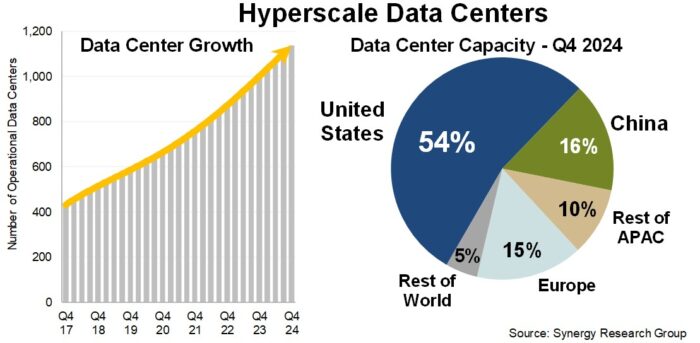
Overall, the growth of hyperscale data centers is driven by the demand for AI, cloud computing, big data analytics, and more. All of these applications require massive amounts of computing power and storage, which is exactly what hyperscale facilities are made for. These percentages will only continue to rise, as hyperscale infrastructures are currently being planned, built, or equipped.
Hyperscale Data Center Solutions
Data centers handle large numbers of servers, storage systems, and connected devices. Supporting these high-performance workloads and remote operations requires advanced resources such as high-performance computing (HPC), GPU infrastructure, edge computing, virtualization, scalable storage systems, high-speed networking, cloud integration, automation tools, and security solutions.
Additionally, remote work is becoming normalized across various industries. This means that businesses need hyperscale infrastructures that can support distributed teams remotely. By delivering high-performance computing and storage capabilities, hyperscale infrastructures are a reliable solution for those who need to support remote workforces.
If you need a hyperscale solution, our HyperShelves and Modular Rack Shelf are built to provide a reliable and flexible way to scale hyperscale infrastructures. No matter where your employees are working from, they can maintain agility, efficiency, and uptime with our rack shelves. With our rack shelves, you can easily and quickly expand your setup in data centers or testing lab environments!
RackSolutions Modular Rack Shelves
Developers use modular shelves in mobile device test labs to design and test apps, software, and websites on real devices. Other test labs environments that can benefit from using the modular rack shelf include streaming service labs, AI model training and machine learning environments, cloud computing labs (public, private, hybrid, or multi-cloud), high-performance computing labs, virtualization testing environments, and more.
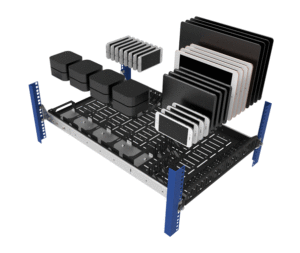
The RackSolutions Modular Rack Shelf offers a flexible solution for housing multiple devices on a single shelf. You can select from brackets for mobile devices, home entertainment systems, computers and laptops, and accessories.
RackSolutions HyperShelves
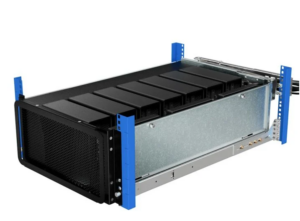
The RackSolutions HyperShelf provides a high density and cost saving PC rack mounting solution for hyperscale data centers and enterprise deployments. Instead of multiple 1U rack shelves to manage devices, the 2U-5U HyperShelf increases shelf density, decreases deployment times, and achieves a massive amount of computing power.
Multiple small form factor devices can be mounted into a shelf, even while running at full load. From the quick mount rail mechanism to designated cable pathways and removable side panels, a HyperShelf helps to enhance airflow, cable management, and machine density.
RackSolutions HyperShelf Technical White Paper
Scalable, space-saving, and built for modern IT infrastructures, RackSolutions HyperShelves are designed to accelerate deployments, cut costs, and improve operational efficiency, whether you’re running a small business or managing a hyperscale data center. Our HyperShelf Technical White Paper explores how to redefine the workspace to support the rise of remote work, implement high-density PC mounting strategies that save space and money, and achieve up to 40% more CPU core capacity without expanding your footprint. To learn more, check out our HyperShelf Technical White Paper for more information.
Contact Us
For Hyperscale Solutions or mounting equipment such as server racks and rack rails, please contact our sales team for assistance. If you don’t see what you need, let’s talk about making a custom solution for you. At RackSolutions, we’ll help you get the right equipment for your data center or testing lab!
FAQs : Hyperscale Data Centers
What is Generative Artificial Intelligence?
Generative Artificial Intelligence (AI) is an AI model that creates new content and ideas. This includes conversions, stories, images, videos, and music. It can learn human language, programming languages, art, chemistry, biology, or any other complex subject matter. To solve new problems, Generative AI reuses what it already knows. While Artificial Intelligence (AI) is the broader concept of making machines more human-like, Generative AI is a subset category designed to generate new content meaningfully.
What is a Hyperscaler?
Hyperscalers operate by using hyperscale computing. This involves building and managing massive, distributed computing environments. These are the types of environments that rapidly scale up or down to accommodate vast amounts of data and user demands. The big 5 hyperscaler are Amazon’s AWS, Google Cloud, Microsoft’s Azure, IBM Cloud, and Oracle Cloud.