Data center sustainability is the practice of designing, building, operating, and maintaining data centers in a way that minimizes environmental impact while maximizing efficiency and performance. As data centers continue to grow, so do environmental concerns. This makes it essential for businesses to prioritize energy efficiency and adopt renewable energy sources. By doing so, organizations can reduce their footprint while supporting long-term performance and growth.
Why Is Sustainability Important?
With the demand for technology growing, data centers consume large amounts of energy and water to support it. While they are essential to modern business operations, they can also be resource-intensive. By using sustainable practices, businesses can meet growing computing demands without compromising future resources. Key sustainable data center practices include:
- Energy Efficiency – Optimizing proper power usage through efficient hardware, power distribution, and reduced energy waste.
- Cooling and Airflow Management – Implementing efficient cooling strategies and management to reduce energy consumption. Strategies include hot/cold aisle containment and proper airflow design.
- Renewable Energy Use – Incorporating clean energy sources like solar or wind to power data center operations.
- Efficient Hardware and Infrastructure – Utilizing energy-efficient servers, storage, and networking equipment to deliver higher performance with lower power consumption.
- Monitoring and Optimization – Using tools to track power, temperature, and data center performance in real time to continuously improve efficiency and reduce waste.
5 Key Benefits of Sustainable Data Centers
Sustainable data centers provide both environmental and operational advantages for businesses. Here are the 5 key benefits of sustainable data centers for businesses and the environment:
1. Lower Operating Costs
Energy-efficient systems reduce power consumption. This leads to significant cost savings over time. When utilizing efficient cooling systems, low-power servers, and optimized designs, sustainable data centers can reduce energy consumption compared to traditional data centers.
2. Improved Energy Efficiency
Efficient cooling, proper airflow management, and optimized hardware help reduce energy waste and lower power consumption. This leads to better performance while minimizing unnecessary energy use.
3. Increased Equipment Lifespan
Proper thermal management and a well-designed infrastructure reduce strain on IT equipment. By maintaining stable operating conditions, businesses can extend the lifespan of their hardware and reduce replacement costs.
4. Regulatory Compliance
Sustainable data center practices help businesses meet regulatory requirements while supporting scalability and adaptability. This approach allows organizations to keep pace with evolving technologies, avoid costly infrastructure upgrades, and maintain long-term efficiency.
5. Increased Reliability
Sustainable data center designs support long-term growth and adaptability. By incorporating advanced technologies and efficient infrastructure, they help extend the lifespan of existing systems and reduce the risk of outages. This ensures consistent performance and better service continuity for businesses and their customers.
Key Factors Businesses Should Consider
Businesses should consider several key factors to improve data center sustainability. Energy efficiency is critical, and metrics such as Power Usage Effectiveness (PUE) help measure how efficiently a data center uses power, with lower PUE indicating better performance. Cooling and airflow management also play a major role.
With strategies such as hot and cold aisle containment, liquid cooling, and proper rack spacing, it helps to reduce energy consumption. Additionally, using energy-efficient hardware, such as servers, storage, and networking equipment, can deliver higher performance while using less power.
Scalability and modular design are also important to ensure data centers can grow without overbuilding or wasting resources. Incorporating renewable energy sources, such as solar or wind, helps reduce reliance on traditional power. Plus, monitoring and automation tools such as Data Center Management Software (DCIM) systems allow businesses to track power usage, temperature, and equipment performance in real time. This allows for continuous optimization and improved efficiency.
Why Does Cabinet Design Matter?
The physical design of data center cabinets and server racks plays a critical role in overall efficiency. It directly impacts how effectively cooling systems operate, how much strain is placed on IT equipment, and how stable thermal conditions remain over time. In most environments, inefficiencies can force facility systems to work harder. This increases energy consumption, accelerates equipment wear, and reduces the effectiveness of other sustainability efforts.
Common factors that contribute to airflow and cooling challenges include:
- Disrupted Airflow Paths: Poorly defined or inconsistent intake and exhaust paths across racks can reduce cooling efficiency
- Cable Congestion: Excess or disorganized cabling can block airflow, leading to heat buildup and pressure imbalances
- Hot Air Recirculation: Hot air can circulate back into equipment intakes, causing higher temperatures and reduced performance
Overall, prioritizing cabinet design as part of sustainability can improve PUE, lower energy consumption, and strengthen infrastructure reliability.
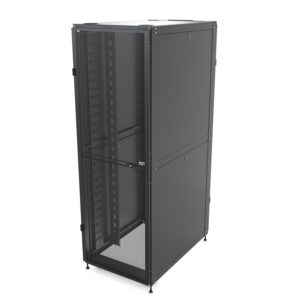
RackSolutions Server Racks and Cabinets
RackSolutions offers a range of server racks, colocation cabinets, and rack accessories designed to support efficient and scalable data center operations. With a focus on quality, airflow optimization, and durable in-house manufacturing, our solutions help businesses improve performance while supporting long-term sustainability goals.
If you don’t find a product that fits your needs, we also offer custom solutions tailored to your specific requirements. Our team is here to help you find the right fit for your environment!
FAQs: Data Center Sustainability
How can businesses improve the sustainability of their data centers?
Businesses should optimize energy efficiency, implement effective cooling and airflow strategies, and incorporate renewable energy sources. Monitoring power usage, upgrading to efficient hardware, and designing for scalability also helps to reduce waste and improve long-term performance
What technologies or equipment support sustainable data center operations?
Technologies such as energy-efficient servers, intelligent power distribution units (PDUs), advanced cooling systems, and data center infrastructure management (DCIM) tools support sustainable data center operations.
How does data center design impact energy efficiency and sustainability?
Data center design plays a critical role in sustainability by influencing airflow, cooling efficiency, and space utilization.
What is a Green Data Center?
A green data center is a sustainable facility designed to minimize its environmental impact while maximizing energy efficiency. It incorporates innovative technologies and practices to host and process vast amounts of data in an environmentally responsible manner. It significantly reduces their carbon footprint by utilizing energy-efficient infrastructure, optimizing cooling systems, and implementing renewable energy sources.
To maximize operational efficiency and sustainability, the major fundamentals of green data centers are: energy efficiency, optimal hardware design and sustainable infrastructure, resource management and monitoring, resource optimization, regulatory compliance, and waste management.