Server cabinets are essential for organizing and housing IT equipment in data centers and computing environments. To optimize performance and scalability, choosing the right data center cabinet is crucial. When deciding between custom and standard data center cabinets, the choice depends on your equipment needs, layout, and long-term infrastructure goals.
In this guide, we’ll explore the differences, benefits, and best use cases for each type (custom, standard, hybrid) so you can choose the most efficient solution for your setup!
Standard Server Cabinets
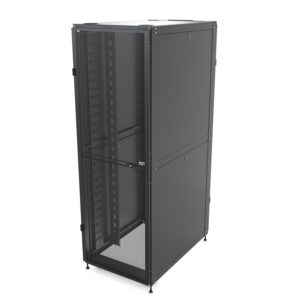
Finding the right server cabinet usually means deciding between a standard design or a custom-built solution built for your specific requirements. Standard server cabinets, also known as off-the-shelf racks, are pre-manufactured solutions made to accommodate a wide range of IT equipment. Because standard cabinets come in industry-standard sizes and configurations, they’re readily available and easy to set up.
Key Features
- Pre-Manufactured Design: Off-the-shelf cabinet designs are ready-made and stocked for immediate availability. This reduces lead times and simplifies the purchasing process for customers.
- Industry-Standard Sizes: Available in standardized rack dimensions, such as heights of 42U and 48U, with a standard width of 19” and varying depths. This ensures a reliable fit for most IT and networking equipment.
- Universal Mounting: Fits a wide range of servers, switches, routers, IT accessories, and more from different manufacturers.
- Durable Construction: Built from high-quality steel or aluminum for long-term reliability in data center and computing environments.
- Cable Management Support: Cable routing channels, tie points, and cable trays helps to simplify wiring and improve accessibility during maintenance.
Key Benefits
- Cost-Effective: Lower upfront costs make standard cabinets a great choice for budget-conscious deployments.
- Quick Deployment: Easily accessible and simple to install, allowing teams to quickly set up systems.
- Low Maintenance: Standardized components make maintenance and replacements easy for IT teams.
Potential Drawbacks
- Space Requirements: Standard cabinets need adequate room for installation and ongoing service. In tight environments, limited clearance can affect airflow, door swing, cable routing, and equipment access, making it important to choose a rack that fits the space to ensure proper cooling and easier maintenance.
- Limited Flexibility: There are fewer options for door configurations, airflow control, and sizing, which may not meet the needs of custom environments.
- Future Constraints: As workloads continue to grow, they may struggle to support higher rack densities or advanced cooling methods.
Custom Server Cabinets
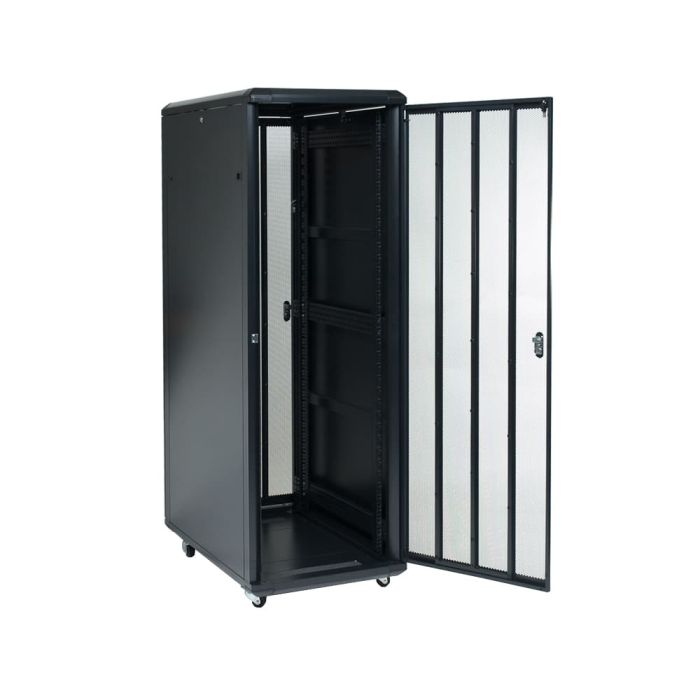
Custom server cabinets provide tailored solutions designed around specific equipment, space, and performance requirements. This is ideal for businesses with unique infrastructure needs and performance requirements. Unlike standard cabinets, this flexibility provides a perfect fit for complex configurations, non-standard equipment, and work environments that require maximum efficiency.
Key Features
- Custom Design and Fit: Custom cabinets are built to meet specific equipment, layout, and cooling requirements for unique data center environments.
- Flexible Dimensions: Provides customized height, width, and depth options to fit non-standard equipment and space-limited work environments.
- Integrated Accessories: Include custom cable management, airflow panels, power distribution, and mounting configurations based on your requirements.
- Enhanced Airflow and Cooling: Improves thermal management and cooling for high-density and specialized hardware setups.
- Space Utilization: Ensures that your cabinet perfectly fits within its designated area.
Key Benefits
- Improved Efficiency: Custom cabinet configurations improve airflow, cable routing, and accessibility. With all these improvements, teams can reduce downtime and maintenance.
- Enhanced Scalability: Built to support future growth, custom cabinets can be easily expanded, modified, or replaced as your infrastructure requirements evolve.
- Long-Term Value: The upfront cost is higher, but a custom cabinet can improve performance and reduce operational inefficiencies over time.
Potential Drawbacks
- Longer Lead Times: Custom cabinets are built to order, so production and delivery may take longer compared to standard cabinet options.
- Limited Flexibility: Modifications can be difficult or costly after production, especially if infrastructure requirements change later.
- Compatibility Challenges: Because they are tailored to specific hardware, custom cabinets may need modifications to support future equipment changes.
How to Choose the Right Server Cabinet
Choosing between a custom and standard server cabinet comes down to understanding your project’s priorities. This involves speed, cost, flexibility, and long-term business growth. Start by evaluating your equipment requirements: if your hardware follows industry-standard sizes, a standard cabinet is the simplest and most cost-effective choice. For specific or non-standard equipment, a custom cabinet is beneficial to ensure a proper and reliable fit. You should also consider your timeline and budget as well, as standard cabinets offer fast availability and lower upfront costs, while custom cabinets require more time and investment.
Additionally, you need to assess your space constraints, cooling needs, and future expansion. If your business expects rapid growth, complex airflow requirements, or a data center environment that demands precise layout control, then a custom solution offers long-term value. Ultimately, the best server cabinet choice depends on your infrastructure goals, installation environment, and how much flexibility you currently need now and in the future.
Hybrid Server Cabinet Solutions: Combining Standard and Custom
Some data center projects may benefit from a hybrid approach, combining both standard and custom server cabinet options. This is beneficial for those that need the cost savings and fast availability of standard racks while meeting unique requirements through specific customization.
At RackSolutions, we specialize in flexible engineering and modular customization. Our engineering team works closely with leading OEMs, creating modular and off-the-shelf designs to meet unique requirements and diverse infrastructure needs. This allows our team to deliver tailored solutions without the complexity often associated with fully custom builds.
For example, you can start with standard cabinets for general-purpose equipment, then integrate custom or modified units only where specialized dimensions, enhanced airflow, or unique cable routing are needed.
Overall, RackSolutions offers a level of flexibility that many manufacturers cannot match. By working directly with leading OEMs, we create off-the-shelf solutions engineered specifically for equipment from Dell, HP, HPE, Lenovo, Apple, and more.
If your project requires something slightly different, our engineering team can configure and resize our existing rack designs to fit your equipment and space requirements. This approach delivers the precision of a tailored solution with significantly faster turnaround times than creating a fully custom rack from the ground up. With RackSolutions, you get solutions engineered for your exact hardware, environment, and deployment timeline.
Why Choose RackSolutions for Your Server Cabinet
RackSolutions bridges the gap between fast-turn standard racks and fully engineered configurations for enterprise, OEM, and hyperscale environments. Thanks to our USA manufacturing, even our custom server cabinets move quickly from concept to delivery. But the real difference is how we work with you.
You can pick from three types of solutions tailored to different requirements: off-the-shelf, configurable, and customizable.
- Our off-the-shelf products come in standard sizes and are ready for immediate deployment.
- If you need a familiar design in a new or different size, our configurable options let you adjust an existing product without moving into a fully custom build.
- For projects that require something built from the ground up, our customizable solutions are engineered specifically for your equipment, layout, and performance requirements. This option ensures you never have to overpay for customization when a configuration change will do, and you never have to settle for a standard size when your environment calls for something unique.
We do more than point you to a product. We guide you in selecting a server cabinet that fits the equipment you plan to deploy, whether that’s Dell rails, Mac mini shelves, or a custom/specific product. If you’re unsure about what you need, our engineers will help you find the right fit. Contact us today and our support team will be ready to assist!
FAQs: RackSolutions Server Cabinets
What is the purpose of a server cabinet?
A server cabinet organizes and houses IT equipment such as servers, switches, routers, and more. It helps to improve airflow, reduce clutter, and protect hardware from physical damage while maintaining performance and reliability. It also helps to optimize space utilization while protecting equipment from dust, tampering, and accidental damage.
What size server cabinet do I need?
The correct size depends on the number of devices you plan to install, equipment dimensions, and future expansion needs. Most standard racks are 19” in width, but heights may vary, so you may need to consider a custom rack cabinet to ensure proper fit.
What is the difference between an open frame rack and enclosed cabinet?
Open-frame racks provide easy access for installation and maintenance, making them better suited for secure or climate-controlled environments. Enclosed cabinets include doors, side panels, and cable management features that support better cooling, physical protection, and noise reduction, making them ideal for data centers, shared spaces, or offices.