The idea of space-based data centers may sound unlikely, but it’s a project that is beginning to take off. Whether you believe it’s science fiction or not, it could be the next step in cloud storage and more. So are data centers really headed to space? We’ll explore the benefits, challenges, and future of space-based data centers, along with the leading companies paving the way for the next era of terrestrial computing.
The Key Benefits of Moving Data Centers To Space
Advocates of space-based data centers highlight key benefits such as unlimited access to solar power, natural cooling temperatures, rapid deployment, orbital edge computing, and better security. and the massive amounts of physical space for expansion. By moving data centers to space, it also helps to reduce the environmental impact of terrestrial data centers.
- Energy and Scalability – Compared to earth-based facilities, space offers direct and unlimited access to solar power and physical space. Space-based data centers will be able to grow to gigawatt scale without terrestrial constraints.
- Increased Cooling – For enhanced energy, space allows for efficient heat dissipation and natural cooling temperatures.
- Rapid Deployment – Even though there are deployment challenges, space-based facilities can rapidly scale while providing high-speed connectivity and data processing services to remote locations on Earth. With satellite networks such as Starlink improving their latency, the connectivity barrier is decreasing. Due to the vacuum of space, laser-based communications between satellites could offer faster data transfer than terrestrial fiber networks.
- Orbital Edge Computing – By positioning edge computing near the data source, space-based facilities allow real-time processing for space-based uses. This includes satellite networks and remote sensing.
- Enhanced Security – When operating outside of terrestrial networks, space-based facilities offer enhanced security from terrestrial threats.
- Reduced Environmental Impact – Space-based facilities address the growing power and cooling demands by serving as a sustainable alternative to power-intensive Earth-based data centers.
Which Companies Are Developing Data Centers in Space?
The 3 leading companies who are actively developing and showcasing space-based data center projects are Starcloud, Lonestar, and Axiom Space. These companies play a major role in meeting the growing demand for AI processing, supporting future space missions, and offering sustainable alternatives to Earth-based facilities.
Starcloud
Formally known as Lumen Orbit, Starcloud is building data centers in space to provide GPU compute towards other satellites. They plan to also address the rapid increase in demands for energy caused by the deployment of AI. In partnership with NVIDIA’s Inception Program, Starcloud is launching a demonstrator satellite in late 2025. This satellite is built to have 100x more powerful GPUs than the amount that has ever been deployed in space.
Due to AI’s impact and growth on businesses, the energy demand for its development is also rapidly increasing. Philip Johnston, CEO of Starcloud, explains the “plan to build data centers in orbit, where they’ll have unlimited access to solar power and the natural cooling of space.”
Further, AI-related electricity consumption is projected to grow 50% annually through 2030. At the moment, Starcloud plans to launch a powerful orbital data center in 2026. Their first commercial satellite, Starcloud-2, features a GPU cluster, persistent storage, 24/7 access, and proprietary thermal and power systems within a small form factor. It provides advantages for both in-space users and terrestrial users:
- For In-Space Users, Starcloud-2 enables real-time, high-volume data analysis of the terabytes of raw data. This is generated by spacecraft and space stations. When processing this data in space, it delivers low-latency insights derived from Earth observation satellites’ raw data. As a result, it eliminates downlink bottlenecks and avoids massive raw data transmissions to Earth.
- As for Terrestrial Users, Starcloud-2 provides secure global data storage and premium sovereign cloud computing that is fully independent of Earth. This ensures high-performance computing and critical data backup in a sovereign, highly redundant environment.
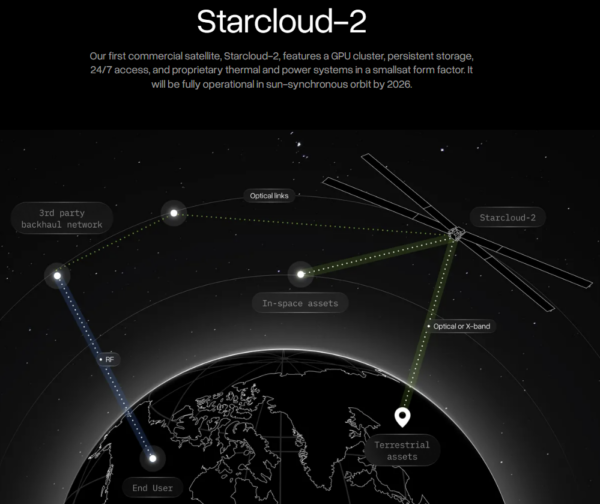
Overall, Starcloud-2 will be fully operational in sun-synchronous orbit by 2026. Within a decade, Starcloud believes that most new data centres will be in space by then.
Lonestar Data Holdings
Secondly, the idea of placing data centers in Earth’s orbit or beyond has been talked around for years. Lonestar Data Holdings is pioneering a new class of premium data storage and edge processing services. Their goal is to create a premier data secure network to service terrestrial, space, and lunar based digital infrastructure.
.jpg)
According to Christopher Stott, chairman and CEO of Lonestar Data Holdings, he says that “high-intensity solar energy and radiative cooling make the prospect highly attractive, and potentially cost-effective. Terrestrial facilities operate at a cost about 5 cents per kilowatt hour (kWh) for the least expensive power, while a celestial datacenter can lower the figure to about 0.1 cents per kWh, including launch costs.” Ultimately, this can lead to operating costs that are 97% lower than on Earth.
On St Petersburg, Florida, August 20th 2025, Lonestar Data Holdings announced the success of its tests for the Solar System Internet (SSI) of their ground-breaking Delay Tolerant Network (DTN) test. This test leveraged the edge processing capabilities aboard Lonestar Data Holdings’ data center mission enroute to the Moon. For more details on the Solar System Internet (SSI) project, you can read about it here.
“Space-based datacenters are a natural next step for all terrestrial computing. In the same way we leverage space for communications, we can now leverage it for data,” Stott said. Lonestar plans to launch a payload into lunar orbit this year, with the goal to build out a series of purpose-built lunar-orbiting data storage spacecraft in 2027.
Axiom Space
And lastly, Axiom Space reimagines how humans live and work in low-Earth orbit. These experiences offer the unique perspectives needed to advance civilization for the next chapter of the human story. They operate at the forefront of commercial innovation in low-Earth orbit with strategic partnerships to perform commercial missions to the ISS, all while building the next innovation platform for beyond tomorrow. With their access program, they provide access to critical work and expand global access.
Other than processing power on Earth, orbital data centers are essential to the increasing number of astronauts and researchers working in space. With support from NASA’s Commercial LEO Development Program, the first module of Axiom Station is planned to dock with the International Space Station as early as 2026. Over time, the station will expand in capability until it can detach and operate independently.
They anticipate that its space station will host a growing demand of crew members who require reliable cloud services. To support their crew members, Axiom Space is developing an orbital data center capability (ODC T1) that will help lessen dependence on Earth-based infrastructure. Plus, these orbital data centers utilize laser-based communication systems called “optical intersatellite links (OILs)” to securely transmit data to other satellites. Due to its modular design, the system will expand as demand increases. They will also be able to provide a pressurized environment that allows standard hardware to operate safely, away from the harsh conditions of space. Even though Axiom Space is currently focused on low Earth orbit (LEO), they may explore opportunities further out in the solar system in the future.
Axiom Mission 4 (Ax-4)
Recently, Axiom Space hosted a virtual press conference with the Axiom Mission 4 (Ax-4) astronauts following their successful 20-day mission. The crew shared highlights from their time in orbit, personal reflections, and the broader significance of Ax-4 for their respective countries.

The mission launched on June 25 aboard SpaceX Dragon “Grace” atop a Falcon 9 rocket from NASA’s Kennedy Space Center. After spending several weeks at the International Space Station, the crew safely undocked on July 14 and splashed down off the coast of California on July 15. Not only was the Ax-4 marked as another milestone for commercial spaceflight, but it also showcased the growing collaboration and achievements of international astronauts working in orbit, highlighting the expanding possibilities for humanity in space.
Challenges For Space-Based Data Centers
Although space-based data centers offer significant benefits, they also come with major challenges. Launching hardware into orbit is extremely costly, and even with the natural cooling of space, processors generate immense heat that requires complex radiator systems. Sensitive electronics must also be shielded from extreme temperatures, radiation, and unpredictable conditions of space. On top of those challenges, assembling and maintaining complex infrastructure (whether in orbit or on the lunar surface) adds another layer of difficulty.
Despite these hurdles, companies are tackling these challenges head-on, so it’ll be exciting to see what breakthroughs emerge for space-based data centers in the years ahead!
The Future of Space-Based Data Centers
Companies view space-based data centers as the next logical step to meet growing data demands. With advances in AI, robotics, and satellite constellations, orbital and lunar data center facilities could become a vital component of future tech infrastructure, supporting both space exploration and Earth-based application in the future.
RackSolutions Server Racks and Cabinets
Whether you need a single server rack or multiple for your data center, RackSolutions provides a variety of server racks, cabinets, and rack accessories that are ready to order. If you have any questions about our products, feel free to contact us for more information. With our high-quality, in house manufacturing, you can be confident that you are buying the best equipment possible.
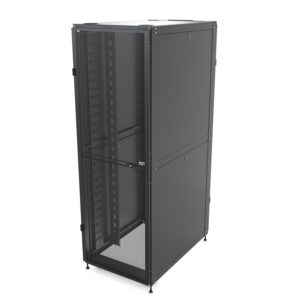
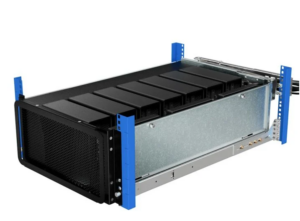
If you need a hyperscale solution, our HyperShelves and Modular Rack Shelf provide a reliable and flexible way to scale hyperscale infrastructures.
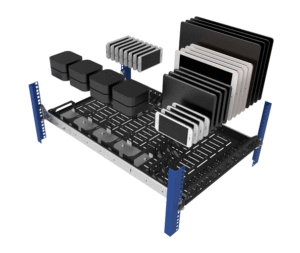
No matter where your employees are working from, they’ll be able to maintain agility, efficiency, and uptime with our rack shelves. With our rack shelves, you can easily and quickly expand your setup in data centers or testing lab environments!
FAQs : Data Centers in Space
Why put data centers in space?
The main reasons why companies are looking to develop data centers in space is to take advantage of abundant solar power and natural cooling. Their goal is to also support global connectivity and satellite-based applications.
Are there research studies exploring space-based data centers?
Yes, organizations such as Thales Alenia Space and the European Space Agency (ESA) are studying the feasibility and potential applications of space-based data centers. Their studies are designed to show how space-based data centers can support long-term data storage and processing of Earth-based observations.